Tuesday, March 29, 2011


Friday, March 04, 2011
It seems to me that there should be another, obvious, meaning of the word emergency – less to do with panic and sirens and alarm bells and red lights, and more to do with everything that Spring is; pale but insistent sunlight, a gentle swell of flowers in the park growing ever more present every day, optimistic hemlines, gentle smiles. A state emerging. A state emergent. In an emergent state. A state of emergency.
My mind somersaults over this concept as I survey late afternoon with morning's newborn eye. Well trodden paths are made new again from the seat of a bicycle; the sounds of life, emerging, and the click-click-click of the bicycle chain. I like that sound. It is the sound of things working as they should be; a sound of quiet efficiency, efficacious, the ineffable satisfaction of all according to a precise plan. There is a maths to it; a balanced equation.
We are supposed to take solace from life, in life. In the elegance of this sort of summation; of everything in its right place. To trace beauty, where we can – trees stretching their winter branches unabashedly, fractal like, against the sky; the rain casting concentric circles in ripples across the surface of puddles; the quiet, yearning hum of the mechanics that are our prison and our mother. I remember, back in Germany, playing the Beautiful Things game, transcending my own self by seeing how many beautiful things I could find to think about so deeply that my mind became them. Raindrops waiting like secrets on the leaves of plants in teracotta, or the smell of gardenias hanging heavy, sultry, in the inky blue black of the summer evening. Sometimes I still find myself cycling on the wrong side of the road (the right side, there – right? Or right? I still check my left from right by holding up my hands in the shape of an L. It is not that I need to, merely that it is a reflex born of treading that same path many times; when it comes to this, the mind is no different from any other creature, preferring the familiar route over the scenic. ((The hands are still the same, but different – still pink, they can hold more sweets now, and chopsticks; but they can play less piano, they have made curse-signs, they have rolled joints, and done other unspeakable things that they are refusing, presently, to even describe by shaping letters into words)) This too, is how I remember which side of the road I should be cycling on – I do not remember what the custom is of this, my homeland, England, but rather in an instant cast my mind back to Berheimer Strasse, und Radfahren zu den Aldstadt, die rechte Seite der Straße, vorbei an bunten Obst und Gemüse, die Barbiere voller türkischer Männer, wo einst das Vorderrad fiel mein Fahrrad und ich stand ratlos und verloren, bis eine Runde lächelnder Mann aus dem Nichts erschien mit einen Schraubenschlüssel und fixiert es für mich, das war die rechte Seite der Straße, radelte ich auf dem richtigen, also in England muss der linken Seite stimmt sein. Das stimmt).
There is a quiet order to such things, that can be seen at such times; before the colourful brash gaiety of summer intoxicates the senses and sparks its feverish dancing, spring wears riches of a more delicate nature. Like spun sugar, and tentative kisses, spring grows as I do – unfurling petals gently, and praying for rain. And slowly, slowly, life ends its hiatus; slowly, sweetly, the music starts again; sweetly, serenely, the world begins to dance. And, briefly, the order of things makes a stark and quiet sense. And sometimes, in the late afternoon, for a few moments, the redbrick houses look like they are made from gold
These are the thoughts that fill my head as I fly through the days, these days. Thoughts of now and then and when, and how and why and what all of those questions even mean and how I fit into the answers. These are good thoughts, thoughts of life and what it means to be alive. Of mornings and afternoons and evenings and nights that loop gently round each other in a loose carousel; and will eventually fold neatly, accordion-esque, into that pack of cards we call a week. Something about the air (pleasantly cold, not in the way of showers and shivers, but clean sheets, a newly made bed I can't wait to ruffle up) catches me dead center and makes me wonder how, when things can be so quietly beautiful, can I be afraid?



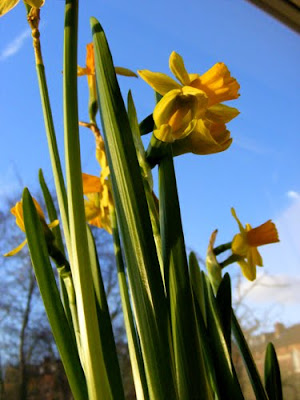
NB I took these photos at the beginning of 2008, in the first proper room I lived in in Leeds, at around the time of year we are at right now.
My mind somersaults over this concept as I survey late afternoon with morning's newborn eye. Well trodden paths are made new again from the seat of a bicycle; the sounds of life, emerging, and the click-click-click of the bicycle chain. I like that sound. It is the sound of things working as they should be; a sound of quiet efficiency, efficacious, the ineffable satisfaction of all according to a precise plan. There is a maths to it; a balanced equation.
We are supposed to take solace from life, in life. In the elegance of this sort of summation; of everything in its right place. To trace beauty, where we can – trees stretching their winter branches unabashedly, fractal like, against the sky; the rain casting concentric circles in ripples across the surface of puddles; the quiet, yearning hum of the mechanics that are our prison and our mother. I remember, back in Germany, playing the Beautiful Things game, transcending my own self by seeing how many beautiful things I could find to think about so deeply that my mind became them. Raindrops waiting like secrets on the leaves of plants in teracotta, or the smell of gardenias hanging heavy, sultry, in the inky blue black of the summer evening. Sometimes I still find myself cycling on the wrong side of the road (the right side, there – right? Or right? I still check my left from right by holding up my hands in the shape of an L. It is not that I need to, merely that it is a reflex born of treading that same path many times; when it comes to this, the mind is no different from any other creature, preferring the familiar route over the scenic. ((The hands are still the same, but different – still pink, they can hold more sweets now, and chopsticks; but they can play less piano, they have made curse-signs, they have rolled joints, and done other unspeakable things that they are refusing, presently, to even describe by shaping letters into words)) This too, is how I remember which side of the road I should be cycling on – I do not remember what the custom is of this, my homeland, England, but rather in an instant cast my mind back to Berheimer Strasse, und Radfahren zu den Aldstadt, die rechte Seite der Straße, vorbei an bunten Obst und Gemüse, die Barbiere voller türkischer Männer, wo einst das Vorderrad fiel mein Fahrrad und ich stand ratlos und verloren, bis eine Runde lächelnder Mann aus dem Nichts erschien mit einen Schraubenschlüssel und fixiert es für mich, das war die rechte Seite der Straße, radelte ich auf dem richtigen, also in England muss der linken Seite stimmt sein. Das stimmt).
There is a quiet order to such things, that can be seen at such times; before the colourful brash gaiety of summer intoxicates the senses and sparks its feverish dancing, spring wears riches of a more delicate nature. Like spun sugar, and tentative kisses, spring grows as I do – unfurling petals gently, and praying for rain. And slowly, slowly, life ends its hiatus; slowly, sweetly, the music starts again; sweetly, serenely, the world begins to dance. And, briefly, the order of things makes a stark and quiet sense. And sometimes, in the late afternoon, for a few moments, the redbrick houses look like they are made from gold
These are the thoughts that fill my head as I fly through the days, these days. Thoughts of now and then and when, and how and why and what all of those questions even mean and how I fit into the answers. These are good thoughts, thoughts of life and what it means to be alive. Of mornings and afternoons and evenings and nights that loop gently round each other in a loose carousel; and will eventually fold neatly, accordion-esque, into that pack of cards we call a week. Something about the air (pleasantly cold, not in the way of showers and shivers, but clean sheets, a newly made bed I can't wait to ruffle up) catches me dead center and makes me wonder how, when things can be so quietly beautiful, can I be afraid?


NB I took these photos at the beginning of 2008, in the first proper room I lived in in Leeds, at around the time of year we are at right now.
Sunday, February 06, 2011
Saturday, January 29, 2011
Why I have no time for Jeremy Clarkson.

I am of the belief that the majority of male TV presenters “of a certain age” can be identified as belonging to one of various subcategories of “Uncle” types. For example, Noel Edmunds is decidedly of the variety of Uncle who you see just once a year, probably around Christmas but not on the day itself, where direct contact is limited to him making a few really gut-wrenchingly awful jokes – at which you laugh anyway, not out of politeness, but with a genuine emotion probably bordering on something that COULD take the guise of pity or even fondness, in the weakest sense of the word. Jeremy Paxman, on the other hand, is a different sort of Uncle – cool, aloof and slightly intimidating, he probably married into your family and likes to see dinner gatherings as a platform for exercising a rigorous wit that would be substantially funnier than that provided by Edmunds, were you not too scared to laugh. His one concession to whimsy is wearing a paper hat from a Christmas cracker, which draws nervous screams of laughter from small cousins, who find the juxtaposition of such floppy cerise headgear in contrast with his steel grey curls shocking in its absurdity.
I can deal with both of these, and other similar, paradigmatic male faces staring out of my television set at me. Like real uncles, their presence in my life is an accident of fate – too distant from any act of volition on my part to demand any explanation, or justification, and of little negative consequence to my own existence. My default position is not one of ill will, more a sort of casual indifference. As a girl, in her twenties, born in 1987 (Thatcher secures a third term in office, British Rail renames Second class as Standard class, Van Gogh’s Sunflowers go for £24,750,000) I have little in common with men born in the 1950s, in the vague climate of post-war altruism; before equal rights for women, before aids, before the internet, when people still paid for things in shillings and nobody got divorced. Why would I? We are creatures of different times, and our interaction must always be analogous to diplomatic missions – this is not to say that we are incapable of finding some common ground, some mutual shared interest that spans the inevitable chasm that arises from generational and gender differences; rather, that any such dialogue that does take place is often one between individuals from very different worlds, and must be treated accordingly. I feel no dislike for them – as I’m sure they do not for me. My response veers between distant curiosity and a polite indifference. Why should it be any other way?
But there is one specimen of TV Uncle who does not give rise in me to such feelings of vague fondness and casual disinterest. There is one archetype who, over a number of years now, has began to grate on my nerves more and more, and is likely to excite dark mutterings from me whenever his portly face barges its way, uninvited, into my living room by way of my TV set. I do not know why my reaction to him has become stronger over the years – perhaps something to do with growing
up, and becoming more sensitive to just how abrasive certain varieties of personality can be? Arrogance, particularly when it is not apparently deserved, fills me with a cold revulsion that leaves little time for the building of any affection, and this genus has it in bucketloads. I am referring to, of course, Jeremy Clarkson.
Clarkson is the sort of Uncle who forgets your birthday, year on year; he is the sort of uncle who notices when you have put on even a pound of weight/accumulated some new spots/are feeling insecure and comments on it loudly, using his boorish wit to undermine and bully you. Clarkson is the kind of Uncle who turns up in his shiny new auto and insists on showing it to the entire family for 40 minutes, telling you all the while about the various features it has in the finest and most excruciating of detail, all the while intimating that he is better than everybody else because he has a better car. The Clarkson archetype not only wants you to know the technical ins and outs of his car, he approaches his presentation of his own life in the same way – and, crucially, not only does he want to tell you all about them, but he genuinely expects you to care. About him, and his things, and his opinion on everything that he deems it relevant to comment on. Which is anything and everything, of course, because Clarkson knows it all.
So, Clarkson has decided that it is his place to wade into the media dialogue about the recent Richard Keys/Andy Gray controversy.For the uninitiated, Keys and Gray were caught on microphone making sexist comments about a female lineswoman. Something of a gaff in itself. They criticised Karren Brady, West Ham vice chair-man, who had recently written a newspaper column about sexism. Then, later footage emerged of them basically behaving like teenage louts, with Gray asking a female assistant to tuck a microphone cord into the crotch of his pants, and later making lewd remarks to Jamie Redknapp and referring to an ex girlfriend on multiple occasions as 'it'.
Clarkson weighing in:
http://www.bbc.co.uk/news/entertainment-arts-12296317
http://www.bbc.co.uk/news/entertainment-arts-12298190
Note the comments on these two youtube videos – often, people seem to struggle with the idea that this behaviour was sexist, preferring to refer to it as “sexist” in inverted commas – as if whether it's wrong to be asking a female member of staff to put her hands next to your dick is open to interpretation. Or here are a few other common angles:
“I think sky sports was wrong to sack gray, firstly this is common joke that men make about women and the second things that football players has a lot of pass and the game is played very fast it is hard for women official’s to keep up with them. If they cannot keep up with them then it will be difficult for female official to make a decision based on off side.
1913Highbury 1 day ago”
“This a laugh at the sheer ridiculousness of PC and sexist stereotypes of women. Ironically because of PC it has screwed two great sports commentators out a job. Women constantly make jokes about male sexist stereotypes such as how men can't multi-task and such.
But when we have a go at them for not knowing the offside rule it's a different story. The only victims of real sexcism here are Andy Gray and Richard Keys.
ScotlandForever1986 2 days ago”
“actually men are protective towards women...and despite the media lies actually like women...conversely women hate men even their own family members and wouldnt save a man drowning in front of em...its women who are sexist...not men..
RichardKeys10 2 hours ago”
“What a way to get sacked... almost like kissing your girlfriend and getting jailed for it...
CraigoohHD 23 hours ago”
“ARE FIFA 11 GOING TO STOP SELLING lol,,thanks to you stupid bitches FOOTBLL is going down the toilet.. what the heck do you want to play or take part in a mans sport,, we havelost our best pundits down to u slags, hope ur happy
spurskimo 1 day ago”.
What concerns me about the furore surrounding the sexist behaviour of Richard Keys/Andy Gray is not necessarily the actions of the two men themselves, who are, let’s face it, just dinosaurs – sad loser remnants of an old industry in the process of rapid modernisation but filled with a pervasive structure comprised of individuals too arrogant to change their ways. (let's face it, they were probably set up by Murdoch, anyway).I feel no bile towards them – no anger. Perhaps this in itself is worthy of concern – that such sexism is, still, so ingrained in our society that I can’t even work up the energy to be offended by it. They’re just a pair of idiots, and when you get caught being an
idiot in the workplace you get called up on it, and that’s just how it goes. Either you don’t behave stupidly, or you do and you don’t get caught. Getting caught leads to facing the music. That’s how it is and that’s what’s happened. No, what I find the most worrying about the whole scenario, is the response of the surrounding media discourse. The narrative woven around any event that permeates the public consciousness is a performance constructed, that the “audience” of the UK may use as a
backdrop for the playing out of their various perceptual fantasies. Hence, to me, this is a story about sexism, and the inevitability of inter-generational conflict, and about how once again, the establishment doesn’t care about the feelings of twenty something females. But for someone else, it is a story about football, and about sport, and about watching the match in a pub when you could still smoke indoors, and a world that’s ever changing, and the sense of losing ones place in it. And for people like Clarkson, this is about the irrelevance of mocking women. It is about how much it DOESN’T MATTER to make derisory comments about girls in a workplace environment. It’s about the fact that, in his eyes, it’s a non issue – it’s about how him and his entitled little cronies should be able to swagger around, staggering under the blunt weight of their balls, ensuring that everyone is exposed to whatever irrelevant bit of fluff they wish to espouse. The media furore surrounding Gray and Keys leaving has become a platform for every one so inclined to express just how unimportant they think it is that two men in a position of power and influence should be held accountable for being caught behaving with astoundingly sexist impropriety and generally behaving like utter idiots. People have weighed in to show just how negligible an issue they think it to be when men behave in a misogynistic fashion in the workplace – apparently advocating the view that, because Keys and Gray are respected sports broadcasters, this should somehow provide mitigating circumstances for their disgusting comments. The implication is presumably that if you are higher up and well respected in your career, your reward is a free license to behave with as much prejudice as you see fit. Misogyny is a reward for success.
Now I am not for one moment suggesting that Clarkson would be remotely bothered by my opinion. In fact, as he has aptly demonstrated, him and his ilk have no concern for the views of me and my kind. Clarkson is as incapable of understanding the feelings of a woman in her twenties as he presumably is of understanding the subtleties of power dialectics in a male dominated industry, of the frustration one feels at being patronised by those with less knowledge or experience purely on the basis of their position of privilege, of the humiliation of having to put up with such behaviour because the hierarchical power structure still so prevalent in our society means that any attempt to challenge it results in ostracisation. Clarkson doesn’t give a fuck what I think. Clarkson cares about what Clarkson cares about, and Clarkson will think about whatever he damn well chooses, it seems – and not pay any heed when the “thought police” come along and start making outrageous requests for things like a respectful working environment and some level of common decency in treatment of co-workers. You know; the sort to point out that anyone with a position of influence funded by license payer money and a platform beamed straight into people’s living rooms has at least some sort of obligation not to justify sexist behaviour in the workplace and, by implication, assert that people shouldn’t be held accountable for violating common standards of decency and respect because it’s all just a bit of banter, after all.
No, Clarkson et al do not understand me. They don’t understand girls like us, who grew up in a world very different to theirs – who have, thankfully, never had the experience, an everyday one for our mothers, of having to grit our teeth and smile while some older lumbering dinosaur of a man patronises and insults us. Of being a second class citizen. We have always known that we are, by default, equal to any man, no greater or no worse; we have always known that we are entitled to have any evaluation of our character and abilities be derived, not on the basis of our gender, but from who we are as people. No, we have no patience for indulging the outdated minority of men who are like Clarkson – and soon, some of us will be in a position to do something about it. The slow progress of the gender equality movement means that more and more girls who think like me will finally begin to infiltrate positions of influence. Soon, girls like me will be hiring, not hired; they will not be lewdly asked to tuck in microphone cords to the crotches of cringeworthy, middle aged men – they will be telling such men to pipe down and do the job they are paid to do. We won't have to indulge your hyper inflated egos – why would we put up with being talked to like that? You're on the way out; we're just discovering our own power; you're the old, we're the new. Don't mistake your dominant ideology for ours. Our generation, both male and female, is one that has grown up expecting equality; of both males and females in the 20 -30 age bracket, views expressed jokingly by Gray and Keys vouched for by Clarkson seem antiquated and soon it is us who will be in charge. So here is my message to Clarkson, the man who does not understand, us, and does not wish to – I don’t wish to understand you either. Stand aside, dinosaurs – your time is nearly over. Soon, this will be our world – and do not be surprised if, given how irrelevant you deem our feelings to be, we extend you a similar courtesy.
Monday, January 17, 2011
Link: Yale Alumni Magazine: Why Yale Favours its Own
This interview with University President of Yale, Rick Levin, discusses the issue of 'legacies' being given consideration when deciding amongst university applicants. Although this idea might seem alien to us in the UK, it is standard practise for universities like Yale - elite institutions, privately owned and as such with more freedom to decide the criteria on which they accept applicants than in our own country.
A quote:
We admit applicants need-blind. The admissions applications are kept separate from the financial statements. But we do advise the admissions office about applications coming from the children or grandchildren of significant donors and of alumni who have given significant volunteer service.
So there you have it, in black and white. You can buy your way into an elite American educational institution if your parents are wealthy enough.
The admissions rate for legacies is about 30 percent—three times the rate for non-legacies.
Is this really the direction we want our own education system to head in? Surely admission to University should be based upon academic ability, not how wealthy a background one comes from.
Friday, January 14, 2011
On floor 13, nobody can hear you scream..
A kind of collective madness has descended upon the Edward Boyle Library as students prepare for examinations. Dressed hurriedly and with absence behind the eyes, people pass fleetingly on stairways, linger for brief snatches of conversation as an oasis in the insanity.
As tablespoons to Prufrock, so my life is measured out in cigarettes. I stagger between walls of books like a madwoman, a cigarette dangling limply from my lips like so many unspoken words...I wish that I could eat my words. The temptation to do so, to actually physically sit down and chew every single reading that somehow my brain needs to incorporate into my mind, is actually far more tempting right now than identifying one more set of Key Terms and Action points.
Facebook has ceased to become merely a mosquito-like distraction and has instead doing a passable imitation of being a window to the real world; when one is seated in the darkest rooms of Revision Hell, it is always SO appealing to look out of the window.
I simply CANNOT WAIT to remember what it's like to have fun again. Come next Wednesday, you will not see me for dust, because I am going to paint this town so gloriously crimson red, you will think we are living in a land of perpetual sunrise. See you on the other side...
As tablespoons to Prufrock, so my life is measured out in cigarettes. I stagger between walls of books like a madwoman, a cigarette dangling limply from my lips like so many unspoken words...I wish that I could eat my words. The temptation to do so, to actually physically sit down and chew every single reading that somehow my brain needs to incorporate into my mind, is actually far more tempting right now than identifying one more set of Key Terms and Action points.
Facebook has ceased to become merely a mosquito-like distraction and has instead doing a passable imitation of being a window to the real world; when one is seated in the darkest rooms of Revision Hell, it is always SO appealing to look out of the window.
I simply CANNOT WAIT to remember what it's like to have fun again. Come next Wednesday, you will not see me for dust, because I am going to paint this town so gloriously crimson red, you will think we are living in a land of perpetual sunrise. See you on the other side...
Saturday, January 08, 2011
In a country rabid with anger, where the seeds of fear are watered with blood for the golden harvest they provide, the frontiersman walks. He is a man beyond the law; he subsists in the wilderness, in the spaces beyond shopping malls and the senate, cable TV and fast food chains. He grows, like a virus, in the spaces of decivilisation that exist within American society - the conflict that allows for the constant regeneration through violence so integral to the American myth. The spaces that propagate it's current mode of existence. He is the Searcher, but knows not what he seeks.
He becomes a man through violence. It is with fire and brute strength that he asserts his existence. Out there, in the wilderness, there are no mothers. There is no love, or compassion - these are luxuries for others; the slick, sharp-suited fast talker. The frontiersman is no fast talker. He is a fast shooter - shoot first, don't-ask questions later, don't think. Do Not Think. If you think, for one moment, you would see that the myth you seek to inhabit is one with origins that pre-date the stage on which you draw, each morning, the curtains. Do you really cast your gaze, out of your window on the world – mailboxes and sunshine, Americana and waving flags, white picket fences and resilient life - and see a desert, a forest, a harsh land to be tamed?
The forests you stalk are towers of glass and concrete, the wilderness is not one that can be conquered with the gun, the axe, brute strength. You are acting and reacting a simulacra; you are playing a part in a myth that was forged of necessity in a time when the land was still alien and new, and the frontier still crawled its way westward by blood. Those times are gone now. The myth which harkens back to it works in service of something darker. Yet still - when the moon warns of danger, the cries of war echo across ancient planes laid supplicant to the powers of modernity. The frontiersman hears the cry, and he knows only blood.
It upsets me, that far from being an anomaly, events such as today's tragedy seem disturbingly at home in such a landscape. A landscape which calls for individualism, thrives on competition, propagates the myth of the hero, worships the bullet, kills for the dream. "The tree of liberty must be refreshed from time to time, with the blood of patriots and tyrants."? But the golden fruit it bears is rotten, rotten to the core. I would not seek to shed blood for that.
“American Democracy was a form of self murder, always. Or of murdering somebody else.” - DH Lawrence.
He becomes a man through violence. It is with fire and brute strength that he asserts his existence. Out there, in the wilderness, there are no mothers. There is no love, or compassion - these are luxuries for others; the slick, sharp-suited fast talker. The frontiersman is no fast talker. He is a fast shooter - shoot first, don't-ask questions later, don't think. Do Not Think. If you think, for one moment, you would see that the myth you seek to inhabit is one with origins that pre-date the stage on which you draw, each morning, the curtains. Do you really cast your gaze, out of your window on the world – mailboxes and sunshine, Americana and waving flags, white picket fences and resilient life - and see a desert, a forest, a harsh land to be tamed?
The forests you stalk are towers of glass and concrete, the wilderness is not one that can be conquered with the gun, the axe, brute strength. You are acting and reacting a simulacra; you are playing a part in a myth that was forged of necessity in a time when the land was still alien and new, and the frontier still crawled its way westward by blood. Those times are gone now. The myth which harkens back to it works in service of something darker. Yet still - when the moon warns of danger, the cries of war echo across ancient planes laid supplicant to the powers of modernity. The frontiersman hears the cry, and he knows only blood.
It upsets me, that far from being an anomaly, events such as today's tragedy seem disturbingly at home in such a landscape. A landscape which calls for individualism, thrives on competition, propagates the myth of the hero, worships the bullet, kills for the dream. "The tree of liberty must be refreshed from time to time, with the blood of patriots and tyrants."? But the golden fruit it bears is rotten, rotten to the core. I would not seek to shed blood for that.
“American Democracy was a form of self murder, always. Or of murdering somebody else.” - DH Lawrence.
Wednesday, January 05, 2011
I want.

Noirjewelry.com
Jewelry with a narrative behind it is a lot more fun. ESPECIALLY when that narrative involves superheroes.
Friday, December 24, 2010
Wednesday, December 08, 2010
5 Left-field Arguments Against Tuition Fees.
The five arguments against tuition fees given here are not intended to provide a comprehensive summary of the multitude of such arguments within the discourse. There are many more convincing and relevant arguments out there – most of us have probably come into contact with them many times over the last few weeks, and have already formed our own stance on them. The intention of these 5 arguments is not to dismiss the importance of other well-trodden paths, but rather to put forward 5 arguments of varying strength that are not usually discussed within the tuition fee debate, and to provide some counterarguments to those whose conceptualisation of the HE system considers the degree a product.
1)A BA/Sc degree alone is worth little in the job market. How can a student in so much debt afford to fund the 'corollaries' necessary to get that graduate job?
To be appointed to a 'graduate' post in fields like law, media, consultancy, journalism, financial services, etc, etc, etc then you are pretty much expected to have significant work experience on your CV, or to do an unpaid internship, usually based in London. Jobs in such fields, coveted and rare as they are, will go to those who have been able to gain this valuable work experience – sometimes due to 'connections' within the industry. The herd is thinned further by such options only really open to those who can afford to live and work in London for 3 months, UNPAID.
-With £20k plus of debt, that isn't happening any time soon.
-If we consider degrees to be a 'product' that we are investing in, as the establishment is so eagerly encouraging us to do, why would we pay for a product that is not fit-for-purpose?
2)We are told to view our expensive degrees as an investment, as they will help us to net that elusive job – and this justifies the cost. Yet this investment appears to be faulty.
Rapid expansion of student numbers coupled with the commodification of the 2:1 have resulted in a job market oversaturated with the afore mentioned degree classifications. They are rapidly becoming worthless. In order to make their CV stand out from the crowd, students need all sorts of fireworks and cartwheels – it's the voluntary work, work experience, internships and extra curricular activities which will get you the job. Try building an impressive CV to rival that of other candidates when you have to work throughout the academic year and all summer to fund yourself. (many people work for money, not experience)
-Why pay so much money for something that is 'worth' so little to you (in ££££s at any rate, which is how we are being told to evaluate these things)?
3) The commodification of the 2:1 will result in a shift in attitudes towards MA/Sc's, which will devalue the 2:1 further in the job market and result in further inequality of opportunity for those who can afford to pay for an MA/Sc to improve their job prospects, and those who can't.
Following on from the previous argument, over the next few years, jobs that used to require a BA/Sc as standard will, in an effort to sift through the reams of CVs that land on their desks, search desperately for qualities that put some candidates head and shoulders above the others. Inevitably, often those with a MA/Sc will emerge as the stronger applicants. This is a dangerous development. With the increasing tendency for students to study for a MA, not as a result of any genuine desire to further their knowledge or to become part of the Academic institution, but simply as a means of delaying entering the job market in troubled times, this will fairly straightforwardly result in 'two tiers' of graduate
“The average course fees for a one-year postgraduate programme is about £3,000 for students from the EEA (European Economic Area).
Non-EEA students pay on average about £7,000 for an arts subject or £8,000 for a science subject. Clinical studies and MBAs can be about double these amounts.
Living costs for an academic year are about £6,000 (more in London).” (source: http://www.ukstudentlife.com/Course/Postgrad.htm )
With only limited scholarships/funding available and no tuition fee loans to cover the costs of studying, it is fairly obvious that MA's will be prohibitively expensive to the vast, VAST majority of those who don't have private funding to cover the cost of their programme. So, we will have:
+an increasing number of upper middle class students who have studied for a Masters because they can, to avoid entering the job market, etc.
+ so, an increasing number of candidates for graduate jobs with Masters qualifications.
+ therefore, jobs will go to middle class graduates who have been able to afford to study for a Postgraduate qualification in order to make themselves more employable, devaluing the Bachelors even further.
-With £20k+ of debt incurred just from studying for your Bachelors, how will you ever afford to study for an MA necessary to get a good job and actually pay it off? What a faulty product we're being provided with, huh?
4)“It's okay to charge tuition fees, because if you don't end up earning over the £21,000/pa threshhold, then you won't have to pay it back anyway.”
This is often presented as a justification for the fees and their potential impact on those from lower income brackets – often by those, one could wryly note, who would not feel comfortable taking on the millstone of thousands of pounds worth of debt with the expectation that they would never in fact be able to pay it off.
It is somewhat disturbing that we are actually telling poorer students not to worry about the debt they're taking on because when they fail to become a high earner, they won't have to pay it back anyway. Is it already a given that their degree will be worth less than £21,000 p/a to them – where for others, it entitles them to £50k+? Furthermore, when they do break through that £21k threshold, their debt of £20k+ must still be paid off in its entireity, regardless of whether they earn £21k/pa or £120k/pa. And it is also worth noting that many students from higher income backgrounds have access to Bank of Mum and Dad funding which allows them to avoid incurring tuition fee debt in the first place ANYWAY. However you slice it, that £20k+ of student debt is vastly greater for some than for others, and encouraging students to avoid paying it back by not breaking through the earning threshold is teeth-curlingly regressive – evocative of Victorian attitudes towards accepting one's lot in life. The rich man at his castle, the poor man at his gate - lower your sights, those from lower income brackets, and lower your expectations accordingly, then you can the shadow cast by debt mountain.
5)The infantilisation of the next generation.
“Coming of age is a young person's transition from childhood to adulthood.” (source: http://en.wikipedia.org/wiki/Coming_of_age#Australia.2C_New_Zealand.2C_United_Kingdom_and_Ireland.2C_Poland.2C_Ukraine )
“The age of majority is the threshold of adulthood as it is conceptualized (and recognized or declared) in law. It is the chronological moment when a minor ceases to legally be considered a child and assumes control over their persons, actions, and decisions, thereby terminating the legal control and legal responsibilities of their parents or guardian over and for them.” (source: http://en.wikipedia.org/wiki/Age_of_majority)
In the United Kingdom, our age of majority is 18. This is the age at which, in the eyes of the law, the state and our culture, we cease to be children and become adults.
Media coverage of the recent spate of student protests and occupations has, for the most part, described 'agitators' as 'children' – despite the fact that the paradigmatic construction of the 'student' to which they refer is unabashedly 18 and therefore, indupitably adult.
Yet perhaps this is not such a misnomer.
Our Universities are filled with 18, 19, 20, 21, 22, 23, 24 year olds with no/limited experience of the workforce who have never been financially self sufficient and who are, in all fairness, forced by the system to rely on funding from parents or similar. Our society so often defines the worth of the individual on the basis of their financial position; there is a strange shame in grown adults being financially dependent on others. But this is unavoidable – particularly in the case of those from upper level income brackets, who are given less money (smaller loans, no bursaries) precisely because their parents income has been assessed as being sufficient to cover a parental contribution throughout their period of study. Why has this situation arisen – one in which adults who are uniformly 18 or older are still considered to be the financial responsibility of their parents, and as such put in a situation in which they are forced to be so? If you don't qualify for income assessed bursaries, you HAVE to rely on parental contributions to fund your cost of living throughout your studies (or get a job to fund yourself. Working throughout University impacts on the time you can spend studying; it is prohibitive when it comes to taking on extra-curricular activities - the ones which will really get you that job, remember?- and it automatically makes your life infinitely more difficult, and hence reduces the chances of getting a good degree, than someone who doesn't have to work.)
It is not in anybodies interests for universities to produce a strange hybrid of intellectual naivite; Man-children and Girl-Women whose vested interests diverge wildly from those of the rest of society. A generation of infantilised adults, with little in common with other people of a similar age who have not attended a University education,a sense of entitlement and limited real world experience is detrimental to the whole of society.
Tuition fees propogate this system by creating the degree as product, a 'finishing school for the middle classes', where people pay for the 'student experience' and expect mum and dad to foot the bill, where possible. Grown adults are forced to rely, for their cost of living, on other grown adults. It is not a nice thing, for an adult to be utterly dependent on another individual. It is not fair for parents, who want the best for their offspring, to be forced into continuing to fund their lives long into adulthood in order that they are in a position to compete with others from different social backgrounds. It seems that a total reworking of the HE system is ultimately needed to encourage the shift in culture which would be beneficial to all. A living wage for students coupled with the abolition of tuition fees would help to model a system in which studying for a degree is viewed as an academic occupation, be it the first step onto the ladder of academia or a period of intellectual growth and enlightenment, rather than merely a few years joshing around and a route into gainful employment.
These arguments are not the strongest or most powerful that can be made against tuition fees, and indeed (imho) are superceded by the biggest argument of all, which is the ideological one that Academia should not be sacrificed on the altar of market forces. However, they do go some way towards countering certain specific arguments put forward by some who argue that tuition fees provide a progressive model for our education system, and underestimate the detrimental affects they have on society.
Additionally, I think they highlight a number of hidden facets of the problem which have not, as yet, been subject to much attention. There are far more traps inherent in the process of commodification of education than are immediately obvious – some of these will prove to be hidden oubliettes, unnoticed and until they are too deeply entrenched in our culture and system to be challenged. (Sometimes, when I look at the direction in which our country is headed, it terrifies me.)
We are being asked, in some senses, to consider our degrees to be a product, and to evaluate them on the basis of their success in this framework – key criteria, the 'student experience', and how our chances of gainful employment are impacted. Even on the basis of such criteria, we are being sold a product that is not fit for purpose.

1)A BA/Sc degree alone is worth little in the job market. How can a student in so much debt afford to fund the 'corollaries' necessary to get that graduate job?
To be appointed to a 'graduate' post in fields like law, media, consultancy, journalism, financial services, etc, etc, etc then you are pretty much expected to have significant work experience on your CV, or to do an unpaid internship, usually based in London. Jobs in such fields, coveted and rare as they are, will go to those who have been able to gain this valuable work experience – sometimes due to 'connections' within the industry. The herd is thinned further by such options only really open to those who can afford to live and work in London for 3 months, UNPAID.
-With £20k plus of debt, that isn't happening any time soon.
-If we consider degrees to be a 'product' that we are investing in, as the establishment is so eagerly encouraging us to do, why would we pay for a product that is not fit-for-purpose?
2)We are told to view our expensive degrees as an investment, as they will help us to net that elusive job – and this justifies the cost. Yet this investment appears to be faulty.
Rapid expansion of student numbers coupled with the commodification of the 2:1 have resulted in a job market oversaturated with the afore mentioned degree classifications. They are rapidly becoming worthless. In order to make their CV stand out from the crowd, students need all sorts of fireworks and cartwheels – it's the voluntary work, work experience, internships and extra curricular activities which will get you the job. Try building an impressive CV to rival that of other candidates when you have to work throughout the academic year and all summer to fund yourself. (many people work for money, not experience)
-Why pay so much money for something that is 'worth' so little to you (in ££££s at any rate, which is how we are being told to evaluate these things)?
3) The commodification of the 2:1 will result in a shift in attitudes towards MA/Sc's, which will devalue the 2:1 further in the job market and result in further inequality of opportunity for those who can afford to pay for an MA/Sc to improve their job prospects, and those who can't.
Following on from the previous argument, over the next few years, jobs that used to require a BA/Sc as standard will, in an effort to sift through the reams of CVs that land on their desks, search desperately for qualities that put some candidates head and shoulders above the others. Inevitably, often those with a MA/Sc will emerge as the stronger applicants. This is a dangerous development. With the increasing tendency for students to study for a MA, not as a result of any genuine desire to further their knowledge or to become part of the Academic institution, but simply as a means of delaying entering the job market in troubled times, this will fairly straightforwardly result in 'two tiers' of graduate
“The average course fees for a one-year postgraduate programme is about £3,000 for students from the EEA (European Economic Area).
Non-EEA students pay on average about £7,000 for an arts subject or £8,000 for a science subject. Clinical studies and MBAs can be about double these amounts.
Living costs for an academic year are about £6,000 (more in London).” (source: http://www.ukstudentlife.com/Course/Postgrad.htm )
With only limited scholarships/funding available and no tuition fee loans to cover the costs of studying, it is fairly obvious that MA's will be prohibitively expensive to the vast, VAST majority of those who don't have private funding to cover the cost of their programme. So, we will have:
+an increasing number of upper middle class students who have studied for a Masters because they can, to avoid entering the job market, etc.
+ so, an increasing number of candidates for graduate jobs with Masters qualifications.
+ therefore, jobs will go to middle class graduates who have been able to afford to study for a Postgraduate qualification in order to make themselves more employable, devaluing the Bachelors even further.
-With £20k+ of debt incurred just from studying for your Bachelors, how will you ever afford to study for an MA necessary to get a good job and actually pay it off? What a faulty product we're being provided with, huh?
4)“It's okay to charge tuition fees, because if you don't end up earning over the £21,000/pa threshhold, then you won't have to pay it back anyway.”
This is often presented as a justification for the fees and their potential impact on those from lower income brackets – often by those, one could wryly note, who would not feel comfortable taking on the millstone of thousands of pounds worth of debt with the expectation that they would never in fact be able to pay it off.
It is somewhat disturbing that we are actually telling poorer students not to worry about the debt they're taking on because when they fail to become a high earner, they won't have to pay it back anyway. Is it already a given that their degree will be worth less than £21,000 p/a to them – where for others, it entitles them to £50k+? Furthermore, when they do break through that £21k threshold, their debt of £20k+ must still be paid off in its entireity, regardless of whether they earn £21k/pa or £120k/pa. And it is also worth noting that many students from higher income backgrounds have access to Bank of Mum and Dad funding which allows them to avoid incurring tuition fee debt in the first place ANYWAY. However you slice it, that £20k+ of student debt is vastly greater for some than for others, and encouraging students to avoid paying it back by not breaking through the earning threshold is teeth-curlingly regressive – evocative of Victorian attitudes towards accepting one's lot in life. The rich man at his castle, the poor man at his gate - lower your sights, those from lower income brackets, and lower your expectations accordingly, then you can the shadow cast by debt mountain.
5)The infantilisation of the next generation.
“Coming of age is a young person's transition from childhood to adulthood.” (source: http://en.wikipedia.org/wiki/Coming_of_age#Australia.2C_New_Zealand.2C_United_Kingdom_and_Ireland.2C_Poland.2C_Ukraine )
“The age of majority is the threshold of adulthood as it is conceptualized (and recognized or declared) in law. It is the chronological moment when a minor ceases to legally be considered a child and assumes control over their persons, actions, and decisions, thereby terminating the legal control and legal responsibilities of their parents or guardian over and for them.” (source: http://en.wikipedia.org/wiki/Age_of_majority)
In the United Kingdom, our age of majority is 18. This is the age at which, in the eyes of the law, the state and our culture, we cease to be children and become adults.
Media coverage of the recent spate of student protests and occupations has, for the most part, described 'agitators' as 'children' – despite the fact that the paradigmatic construction of the 'student' to which they refer is unabashedly 18 and therefore, indupitably adult.
Yet perhaps this is not such a misnomer.
Our Universities are filled with 18, 19, 20, 21, 22, 23, 24 year olds with no/limited experience of the workforce who have never been financially self sufficient and who are, in all fairness, forced by the system to rely on funding from parents or similar. Our society so often defines the worth of the individual on the basis of their financial position; there is a strange shame in grown adults being financially dependent on others. But this is unavoidable – particularly in the case of those from upper level income brackets, who are given less money (smaller loans, no bursaries) precisely because their parents income has been assessed as being sufficient to cover a parental contribution throughout their period of study. Why has this situation arisen – one in which adults who are uniformly 18 or older are still considered to be the financial responsibility of their parents, and as such put in a situation in which they are forced to be so? If you don't qualify for income assessed bursaries, you HAVE to rely on parental contributions to fund your cost of living throughout your studies (or get a job to fund yourself. Working throughout University impacts on the time you can spend studying; it is prohibitive when it comes to taking on extra-curricular activities - the ones which will really get you that job, remember?- and it automatically makes your life infinitely more difficult, and hence reduces the chances of getting a good degree, than someone who doesn't have to work.)
It is not in anybodies interests for universities to produce a strange hybrid of intellectual naivite; Man-children and Girl-Women whose vested interests diverge wildly from those of the rest of society. A generation of infantilised adults, with little in common with other people of a similar age who have not attended a University education,a sense of entitlement and limited real world experience is detrimental to the whole of society.
Tuition fees propogate this system by creating the degree as product, a 'finishing school for the middle classes', where people pay for the 'student experience' and expect mum and dad to foot the bill, where possible. Grown adults are forced to rely, for their cost of living, on other grown adults. It is not a nice thing, for an adult to be utterly dependent on another individual. It is not fair for parents, who want the best for their offspring, to be forced into continuing to fund their lives long into adulthood in order that they are in a position to compete with others from different social backgrounds. It seems that a total reworking of the HE system is ultimately needed to encourage the shift in culture which would be beneficial to all. A living wage for students coupled with the abolition of tuition fees would help to model a system in which studying for a degree is viewed as an academic occupation, be it the first step onto the ladder of academia or a period of intellectual growth and enlightenment, rather than merely a few years joshing around and a route into gainful employment.
These arguments are not the strongest or most powerful that can be made against tuition fees, and indeed (imho) are superceded by the biggest argument of all, which is the ideological one that Academia should not be sacrificed on the altar of market forces. However, they do go some way towards countering certain specific arguments put forward by some who argue that tuition fees provide a progressive model for our education system, and underestimate the detrimental affects they have on society.
Additionally, I think they highlight a number of hidden facets of the problem which have not, as yet, been subject to much attention. There are far more traps inherent in the process of commodification of education than are immediately obvious – some of these will prove to be hidden oubliettes, unnoticed and until they are too deeply entrenched in our culture and system to be challenged. (Sometimes, when I look at the direction in which our country is headed, it terrifies me.)
We are being asked, in some senses, to consider our degrees to be a product, and to evaluate them on the basis of their success in this framework – key criteria, the 'student experience', and how our chances of gainful employment are impacted. Even on the basis of such criteria, we are being sold a product that is not fit for purpose.

Subscribe to:
Posts (Atom)
